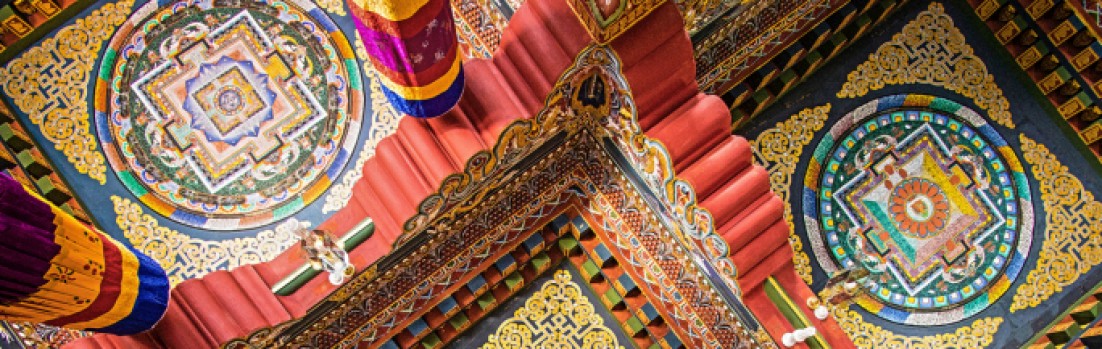
It was definitely on my mind to write a blog about Ahimsa, the first yoga yama (moral restraint )about non-violence. My mental picture of Ahimsa is to watch the ochre -robed monks sweeping the path before they step on any ants. Equally as silly and not-of-this-world is the blockbuster film Revenant Continue reading
Category Archives: Uncategorized
Just Who is Writing This Blog
Every now and then I go through all my papers and try to update my biography. It’s that old saw about writing your own obituary. Which never seems to get done.
But, for years, this blogging never seems to get done. And now I have turned on the faucet. While you are waiting for the next posts, you can check out the latest bio. It is found below this paragraph so scroll down. More important, stay tuned for coming posts about Chair Yoga — aren’t they great ? I borrowed them from Teri, the best Chair Yoga teacher I know. And I will soon be talking more about all that they can do. They only THINK they need the chair !
In fact, by default, I am learning a lot about using chairs as yoga props. This is a normal part of my evolution when I like to hear myself say ( too often these days ) “It’s the old ladies who know how to teach floor poses because it takes a lot of experiences to tell enough stories and cues to keep students happy in floor poses long enough to accomplish something wonderful”. Many of my students have hip or knee replacements ( or they need them and are trying to circumvent the whole surgical process). These folks like to sit down and stand up. So much better than up and down from the floor. We call those the dreadful GET UPS in our circuit training class.
Roberta Strickler Yoga Alliance RYT E-500 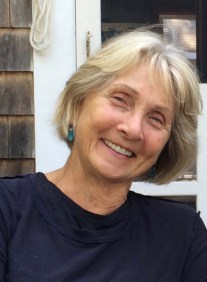 Roberta Strickler began teaching hatha yoga in March of 1995 when there were only a few active yogis in Lancaster PA. So it’s not uncommon to find yogis today who recognize her with “You were my first yoga teacher.” Her teaching style began with her first certificate from Kripalu Center for Yoga and Health In Lenox, MA, where she studied on campus for 28 days to earn a 200-hour basic yoga teaching certificate. Kripalu, then, was still an ashram and its teaching style was well-known for physical and psychological safety. The facility is now an international center for Yoga & Health. The Yoga program still carries a reputation for teaching teachers how to teach, more so than for promoting one style of yoga sequences and beliefs.
In 1999 Roberta met Suzie Hurley at a workshop about inversions and was instantly smitten by the new energy and the clear precise language of Anusara Yoga, which was founded by John Friend in 1998. Based on the yoga model established by BKS Iyengar, Anusara adds grace and heart to Mr. Iyengar’s emphasis on alignment. During the next year, Roberta studied intensively with Suzie at Willow Street Yoga Center in Takoma Park, MD ( and cooked for Suzie and her family to earn her board). Roberta completed nearly 300 hours of Anusara study with John Friend, Suzie Hurley, Todd Norian, Amy Ippolito, Moses Brown and more than 100 hours of “Yoga as Therapy” study with Doug Keller (www.DoYoga.com) and John Friend. As her students age, Roberta has increased her study of physical alignment and posture with Doug Keller, most recently a week-long update in 2015. Knee replacement surgery in 2012 gave her an empathy for the need to enhance flexibility, through yoga therapy, following any joint replacement surgery ( or pre-surgical preparation).
In 1998, Roberta traveled to Mount Madonna, CA, to study Mindfulness-Based Stress Reduction (MBSR) with Jon Kabat-Zinn. She continues to incorporate the practice of mindfulness in workshops and classes, a dominate theme of her current teaching. During that era, Roberta team-taught MBSR in hospital education settings in both Lancaster and Harrisburg. She created a program of Yoga for Breast Cancer Survivors for St Joseph Hospital ( now Lancaster Regional ) and taught it for six years there.
In 2014-2015, Roberta returned to Kripalu to complete a 10-week program in Foundations for Ayurveda. Ayurveda, the sister science to yoga, looks at the basic constitution of each individual person and seeks to correct imbalances that lead to dis-ease and discomfort, through science of food, lifestyle, cleansing practices, and understanding through study of the Ayurveda principles, which include the 8 limbs of yoga.
Roberta teaches group and private yoga lessons, including one-on-one therapy consultations in Harrisburg, York and Lancaster.
Her personal hobbies are dominated by a passion for golf, gardening , and chess or independent films on those days when being outdoors is not an option.
Pioneer Lifestyle
To be a Pioneer in my world of Ayurveda, the many facets of the science are revealed as a part of daily life. We get together every few weeks to share our insights, our research, and our understanding of this beneficial and complex way of going about the maintenance of our health, our aging, our relationships, our eating choices, and all with good humor and friendship.
Each Pioneer begins with a private consultation. Many times the consult will be attended by a husband of another other with whom we share bed, board, marriage, or friendship. We look at the big picture of Ayurvedic wisdom and then we related it to our own basic nature and constitution. Doshas are considered as not one single category, but as part of a very unique and ever-changing set of emotional, physical, intellectual, and psychological properties.
We look at simple occurrences such as the weather, the time of day, the time of year. We convo about sleeplessness, about dry skin, about minor maladies, about our yoga and meditation practices, and so it goes on and on.
The basics, shown here, are represented by our daily diets, the food we choose that balances us or brings about imbalance, no matter how good it feels to be indulgent. Therapeutic oils and the neti pot are tools that have taken on great meaning to us in solving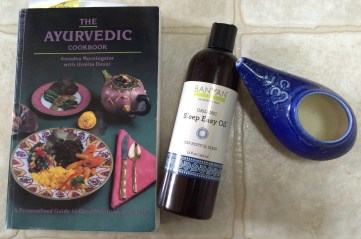 annoying little problems such as sinus infections and insomnia. We have met in an organic grocery store where we could go through recipes and explore new tastes. For example, the ancient grains of millet, quinoa, and a zillion varieties of rice bring new zest to menu planning. The cleansing practices ( called Dinacarya in the Ayurvedic Sanskrit alphabet ) are slow to be adopted without a group meeting where we explore the options of foot massage and the way to use a neti pot without any sign of choking.
Field trips are a lot of fun. We were hosted by an Amish farmer who gave us a tour of his fields and of his non-mechanical flour milling equipment. W e saw the difference between the agriculture developed with heritage grains and then modified to the current practices of growing wheat and rye. When we saw what has happened with the modification of wheat, early in the 20th century, we understood why our bodies resist adoption of that ancient form of protein. We were truly in awe of the work ethic of the farmer who gets help from all of his relatives to plow, harvest, and process grain from seed to flour. This spring we will visit a farm where medicinal herbs and flowers are organically grown and captured for market. No doubt we will plunge into the work of it and spend a day understanding how those little seedlings become beautiful flowering plants.
Please scroll to + Follow our blog. Send an email to mindoveryoga@yahoo.com to receive more information and an application form to be part of this very special pioneer group.

One Labryinth or Another or Another
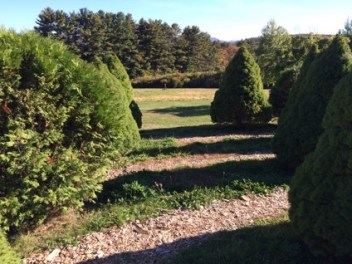 The summer labyrinth at Kripalu. In spring the lupines and the wild flowers bloom in the spaces between the green shrubs. The path is brown dirt and shavings. The center holds memories and icons representing personal samskaras, cast there by dozens of pilgrims. The vista is expansive. The approach is long. An entrance gate allows you to step forth with a sense of ceremony.
 And then, there is this winter walk within the stark gray pebbles and the white smooth stones – a feast of subtle sounds . A center of emptiness. So plain. Only the few green glass pebbles offer the pilgrim a chance to use worry beads – or to leave behind only debris that is found there. Look at this one as a study for construction details for wannabe engineers of circles and spirals. Open and expansive, uncluttered, it invites you in but it gives you lots of space.
Labryinth creators have a choice to invite you to enter right or to enter left. Although this one basically follows the most common clockwise pattern, it is possible to enter to the left, if you are so inclined. I leave it to another day, another research project, another insight of your own, to know whether you wish to begin your walk clockwise or counterclockwise during your next Walking Meditation.
This classic Chartres cathedral styl e labyrinth clearly shows the path in a clockwise rotation. The pathways and the center dais are carefully laid, brick by brick. Here the pilgrim has a sense of being enfolded, of comfort, and of the careful hand of the creator. Of these three examples, this one is in a quiet neighborhood but is only a few blocks from busy traffic . It offers respite. Many thanks to Mark Farmer for his photograph of the labyrinth in autumn.
The Intent of Yoga Becomes Meditation
Nothing is more satisfying to me as a teacher than to spend an hour with a group of yogis who yearn to quiet their minds. In this arena, it’s easy – and so rewarding – to be the teacher who appears when the student is ready. But even Jim, who you see below, could find new material in what was, to me, the same old workshop ! I give this workshop often and I do find there are just a few methods of organization that seem to work well for everyone. Never the same story because it’s never the same group of students.
Sooner and sooner, we get to the gold standard of 20 minutes of sitting in stillness.

To begin, we take a lot of time and a lot of blankets and props and moveable body parts to make sitting comfortable. As one student asked: Is not moving the goal? A great question. Being comfortable is so essential to the process of Mindful Meditation (awareness) that we always need to start there and give everybody a choice of options for allowing the body to relax. As one professional meditator said, If the knees are higher than the hips it just wont happen. The back will round, the head will bow, and it will be impossible to breathe with any sort of ease of well-being.
After we move through several varieties of breath work, we revisit the subject of sitting comfortably. Then, only then, do we get into the hard work: finding ways to focus the mind on just one object. For beginners, we look the usual long, sequential string of thoughts and practice ways to corral them into on unique thought. Perhaps it is looking at one number or another mantra. For some folks it is the rubbing of the traditional 108 mala beads. And always the classic reset: return to the breath.
Learning to meditate in a group is the best way to get started on a personal practise that can last a lifetime.
Not everyone can or wants to sit on your heels. Or cross-legged. Chairs are available. So are zafus, blankets, and individual attention to the options for sitting without back pain or slumping.
Look to the right, here, to sign up to Follow this blog with your email address. If you’d like to arrange a workshop please email to MindOverYoga@yahoo.com.
Namaste.
Bullish about Meditation
 “What does it take to stay alert during meditation? I have a hard time staying awake. My thoughts race through my mind and I can’t get them to stop.”
All of these questions were troubling a most earnest student who desperately wanted to learn to meditate. She was great at partying, another compulsion of her mind, and thought that meditating would help her get her social instincts under control. What I will always remember is trying to “love her” into having any meditation experience. Nothing seemed to work.
My final image of her would be an 8 a.m. group of beginner meditators, sitting together. And there was dear Karen with a can of Red Bull by her knee.
I knew that her dilemma was to get to class and stay awake after a hard night of partying. Taking any stimulant was– to her –the only option. But there was another option : Fall asleep – go ahead and let it happen. You wont sleep forever sitting there and when you wake up you will be refreshed and just maybe inspired by the insights.
Backbends

10 Top Reasons Why God Created Backbends
1. Picking Cherries from a tall tree.
2. Painting the ceiling.
3. Changing oil from under the car
4. Pulling up long zippers in the back of your dress
5. Washing your butt.
6. Applying sun tan lotion to yourself
7. Using your feet for a pillow
8. Taking up less space while sleeping on a futon
9. Reaching your purse that’s in the back seat of your car
and the Top Reason to have backbends in your life:
10. Counting stars in the sky
Grains Deserve A Good Rap
 A simple white rice with some fresh coriander leaves give such terrific health and balancing benefits at such a low price in both time and money . What’s not to like here?
I am in pursuit of the easiest way to eat heathy that will give me respite from a craving for sweets AND the quiet mind. Grains, in Ayurveda, are sweet. They are grounding for Vata and cooling for fiery Pitta, the V_P combination that seems to be in the forefront of the yoga communities of today.
Tuesday evenings at Lemon Street Market begin April 14 at 7 pm. These (not every single week) Tuesdays Around the Table in the back room are designed for small groups to learn more about using food to balance basic constitutional needs – those qualities in yourself that you cannot change but you can learn how to keep them out of excess or being starved out of balance. Call Lemon Street Market at 717-826-0843 to sign up. If you are truly interested in this program, pay in advance to guarantee your seat. We will limit the number of people in order to create a working group that goes home with menu plans each session. More details at http://www.lemonstreetmarket.com
Now, read on for a bit more about the grains and spices we will look at there.

Washing split mung beans on their way to adding protein to rice in the basic Indian stew Kichadi
White basmatic rice is balancing for all three doshas. Coriander (often sold as cilantro) is one of the best spices available for calming. Add some Split Mung Beans (dal) for protein – or add meat if that suits your dosha today.
Although it is quite in vogue to eat no grains, yet the variety that is available in the marketplace today is amazing. High-protein Quinoa and its cousin Amaranth are both warm and dry (Vata take note). Wheat and Barley are both cooling ( Pitta again). Spelt is the lowest-gluten form of wheat that’s easily available by now. The ancient of ancients: Einkorn, then Emmer, are now being grown in the fields of our country because they show some promise in restoring nutrients lost in hybridization mechanics that allow farming in volume.
Lemon Street Market sells so much variety in bulk: at least 8 kinds of rice, plus millet, buckwheat, amaranth, wheatberries, barley, oats, kamut…….
As time goes by we will schedule a trip to farm where heritage grains are grown. One of the subjects we will consider are the various forms of sweetners that are available without causing the imbalances that set you to craving for more. Now that jelly bean season is over.
To begin: Read the blog about The Best Dosha Quiz on the MindfulnessViaYoga.com blog site and take the quiz. Each session will begin promptly at 7 p.m. but come a few minutes early if you want to talk about your dosha – what it is and what it was. See you there!
The Best Dosha Quiz
Getting to know the status of your doshas can be a lifelong endeavor.
Because doshas, like dominoes, go out of balance and take their neighbors with them as they fall, it’s very important to understand and know both your prakruti and your vkruti. Your prakruti, as we say often, is your basic constitution from the moment the sperm met the egg. Prakruti will stay constant over your lifetime but the vikruti will change with circumstances and time and life influences.
You have a ratio of doshas expressed within both prakruti and vkruti. Each dosha (kappa, pitta, vata) varies in strength. And strength differs within your different profiles: physical, mental, emotional, behavioral.
To uncomplicate all these terms, it is best to take the test with a group of other seekers and to be in the presence of a teacher who has at least some study credentials in Ayurveda.
For starters, all the factors can be averaged and this chart is the best one I have found online: http://www.ayurveda.com/pdf/constitution.pdf. In Pioneer consultations we take a longer, more complex test coupled with discussion of ways to monitor your own dosa over time.
Vasant Lad is perhaps the eminent Ayurvedic doctor in the United S tates by now. This is his version of the profile. You want to take it twice: Once for the choices that are consistent throughout your lifetime. Then again for the way you feel recently. It helps to have a friend nearby who knows you well.
Purple Corn Bread !
 Purple, Cakelike, Gluten-free, Organic and lots of fun to make and to eat.
Note to commenters: I cannot find the original recipe but I added butter to this recipe.
Easter colors were not even on my mind when I spied this Organic Purple Corn Meal at the Lemon Street Market, where all things gluten-free nest among the “regular” food. http://www.lemonstreetmarket.com
I know the folks at Spiral Path Farm http://www.spiralpathfarm.com located up the river from us in Perry County. Spiral Path has always gone the extra mile to farm with nature always in mind and their products are especially high quality. The milling of this interesting variety of corn meal is so well done. It makes corn meal look and act like cake flour. But look at some of the reasons they may have considered when they set out to grow this interesting variety of corn.
Purple corn meal got its start way back in the Incan Empire in Peru. (I’ve been to Peru and know there is something powerful and mysterious about these Incan people. Let’s just guess that their prowess may have been supported by their diet, supporting them as they create monuments of huge scope way up top on the hills of the Andes.)
In today’s nomenclature, this is a Superfood that surpasses even Blueberries when it comes to supplying anthrocyanins – the source of antioxidents that are known for anti-inflammatory properties and connective tissue regeneration. What better food could we turn to when we want to cool down the Fire of Pitta dosha, keeper of healthy skin. Before I share a recipe or two with you, let’s look at just two reasons why this food is a balancing “medicine” for doshas. Summer – Pitta’s high season – is just around the corner after Easter comes and goes- and healthy skin in summer is always a challenge. Meanwhile, cool, moist springtime is still with us (Kapha time) , so it’s a good time to acknowledge that Kapha governs the connective tissue between brain cells, where past memories are stored.
It could take a lifetime to understand the intricacy of details that make up the nutritional values converted by doshas. So let’s get busy and do some baking in time to serve cakelike Purple Corn Bread with our pink and yellow Easter eggs.
This recipe uses a lot of fat, here in the form of organic butter. This promotes sweetness and so it calms and soothes Vata and Pitta. Kapha may be aggravated by any high-fat recipe so give your Kapha friends only small portions of sweet, dense food like this bread because they will adore it!
Purple Corn Bread
Preheat the oven to 425 degrees F. Lightly grease an 8-inch baking pan.
In a large bowl, sift together the dry ingredients: 1 cup purple corn meal, 3/4 cup rice flour (You can substitute all-purpose flour if you don’t mind the gluten in it), 1 Tablespoon sugar, 1 1/2 teaspoons baking powder, 1/2 teaspoon baking soda, and 1/4 teaspoon salt. In a separate bowl, mix together the wet ingredients: 2 large eggs, lightly beaten, 3-4 tablespoons melted butter, and 1 1/2 cup buttermilk. Pour the wet ingredients into the dry mixture and fold together until they are no dry spots showing. This batter will be lumpy. Pour the batter into the prepared pan and bake about 20 to 25 minutes or until a tester inserted in the center comes out clean. Let it cool for 10 minutes before serving.
You might experiment with a seasonal theme of powdered sugar lightly sifted over the top of the finished bread. With the finely sifted rice and corn flours this dish is delicate enough to act like a cake!
Please put in your comments if you try this recipe or these flours in other dishes.
 Mindfulness Via Yoga